

Hexagonal Lattice#
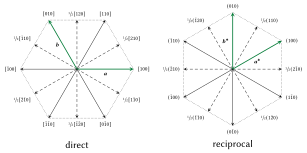
Relationship between direct hexagonal lattice and reciprocal lattice vectors.#
Hexagonal lattices are common in crystallography. Their direct lattice contains two basis vectors \(\mathbf{a}=\mathbf{a}_1, \mathbf{b}=\mathbf{a}_2\) that form \(120^\circ\) in the basal plane, and a third basis vector \(\mathbf{c}\) orthogonal to that plane. The reciprocal lattice retains a hexagonal metric but exhibits basis vectors that are rotated with respect to those of the direct lattice.
This geometrical relationship, combined with indexing conventions, often leads to confusion when interpreting diffraction data or comparing coordinate systems.
Direct and reciprocal hexagonal lattices#
Consider a hexagonal direct lattice with primitive basis vectors
with
The reciprocal lattice basis vectors
also form a hexagonal lattice, but are rotated by \(30^\circ\) in the basal plane relative to the direct basis. This arises from the definition
and the fact that the direct hexagonal lattice is not orthogonal.
As a result:
The direct and reciprocal basis vectors are not parallel.
A reciprocal lattice diagram drawn in the same graphical frame as the direct lattice will appear rotated, even though both are hexagonal.
This rotation has no physical consequence but significantly impacts intuition and indexing.
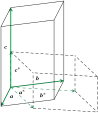
Direct and reciprocal lattice bases for a hexagonal cell. Note the \(30^\circ\) rotation between the bases in the basal plane.#
Miller indices in the hexagonal setting#
In a general lattice, planes are indexed by Miller indices \((h, k, l)\), defined through their reciprocal-space normal vector
In the hexagonal setting, this 3-index notation sometimes obscures the sixfold rotational symmetry because the choice of two axes in the basal plane breaks the apparent symmetry.
The Miller–Bravais (4-index) convention#
To restore manifest sixfold symmetry in the basal plane, the Miller–Bravais notation introduces a four-component index
subject to the redundancy constraint
The additional index does not introduce new information; it enforces that the three in-plane directions are treated symmetrically.
The relation between conventional Miller indices and Miller–Bravais indices is
This conversion is unambiguous only because of the constraint \(i = -h - k\).
Why use the 4-index convention?#
Advantages:
Makes all three in-plane directions symmetry-equivalent.
Clarifies zone axes and family relationships in diffraction patterns.
Simplifies the identification of high-symmetry directions, e.g., \([11\bar{2}0]\), \([10\bar{1}0]\).
Disadvantages:
Introduces a redundant index.
Not widely supported in computational tools.
Requires explicit mapping to 3-index reciprocal vectors.
As a result, it is widely used in materials science (particularly HCP metals, wurtzite semiconductors) and electron diffraction, but rarely used internally in crystallographic software, which prefer the standard 3-index reciprocal-space representation.
Reciprocal basis vectors in Miller–Bravais notation#
In a dual 4-index representation, the reciprocal-space vector becomes
with the constraint
This reflects the fact that the three basal-plane reciprocal vectors are not linearly independent. The vector \(\mathbf{a}_3^*\) exists only to impose sixfold symmetry; it is not a physical basis vector.